
I. Introduction: The Power of Preparedness
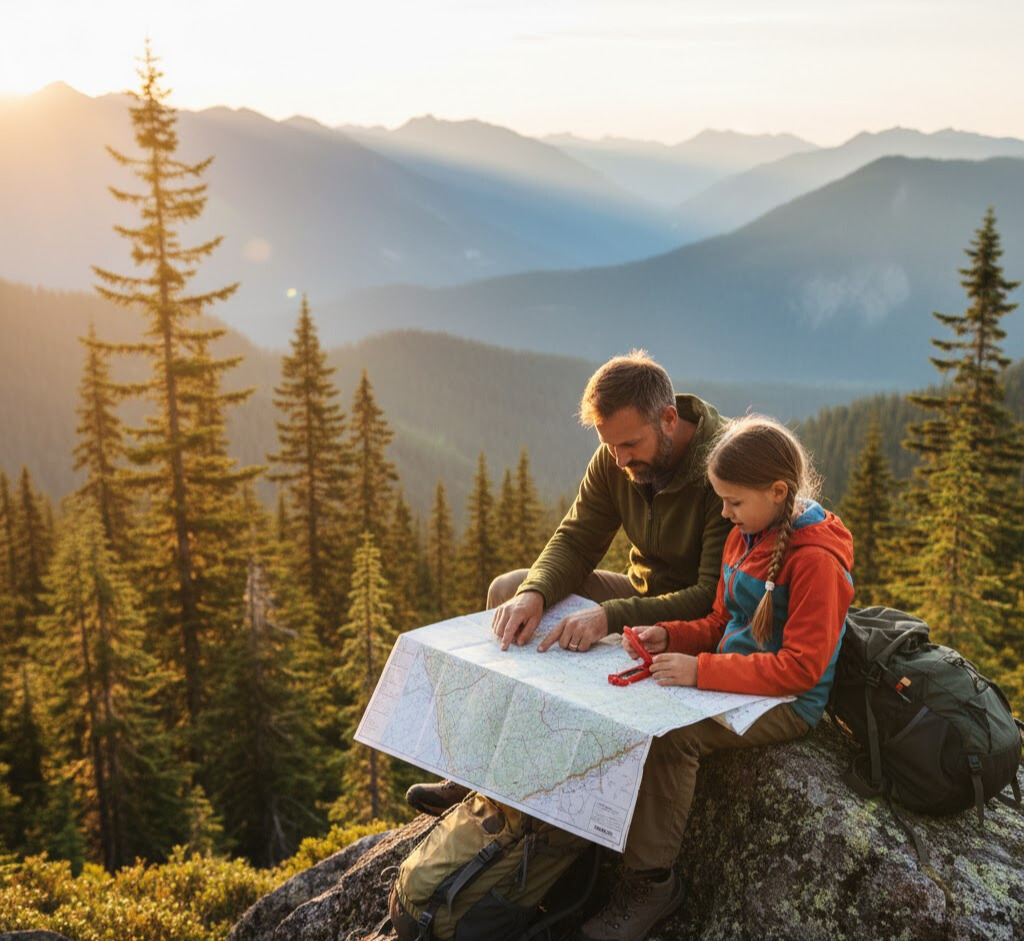
In an age where exploring often happens through a screen, teaching survival skills for kids is more important than ever. While modern technology offers safety nets, it has created a ‘Confidence Gap.’ When the signal bars vanish, children feel helpless. Teaching survival skills is the bridge across that gap.While we teach our children to be adventurous, it’s equally important to follow the disaster preparedness frameworks used by experts. Resources like [Ready.gov Kids] provide excellent age-appropriate tools to help families start these conversations
Beyond the “What If”
Teaching your child how to build a shelter or signal for help isn’t about preparing for a worst-case scenario or fostering a “doomsday” mindset. It is about empowerment. When a child understands the mechanics of the natural world, their perspective shifts:
- Problem-Solving Under Pressure: Survival isn’t just about gear; it’s about logic. Learning to find dry tinder or navigate by the sun trains the brain to look for solutions rather than focusing on the obstacle.
- Taming the Panic: Fear usually stems from the unknown. By replacing mystery with mastery, we give children the tools to stay calm, breathe, and think clearly when things go wrong.
- A Deeper Connection: There is a profound sense of belonging that comes from knowing how to interact with the environment. It transforms the “great outdoors” from a scary, foreign place into a familiar home that provides resources and beauty.
A Note on Safety
Before we dive into the “how-to,” it is vital to remember that survival training is a partnership. These skills should always be taught and practiced under the direct supervision of a responsible adult. Our goal is to build a child’s competence in a controlled, safe environment so that they have the muscle memory to act wisely if they ever find themselves alone.
II. The Core Mindset: The “S.T.O.P.” Rule
Before a child ever picks up a compass or strikes a flint, they need to understand that their most powerful survival tool isn’t in their backpack—it’s between their ears. In a survival situation, your brain can be your best ally or your worst enemy.
The greatest danger in the woods isn’t wildlife or weather; it’s panic. Panic leads to running, and running leads to getting lost deeper in the brush. To combat this, we teach children the S.T.O.P. rule. It is a simple, rhythmic mental anchor that helps them reclaim control of their emotions and their situation.
The Golden Rule: If you realize you are lost, the very first thing you do is stop moving.
S – Sit Down
The moment a child realizes they are lost, their heart rate spikes and adrenaline takes over. The physical act of sitting down signals to the body that the “flight” response is over. It forces them to take a breath, have a drink of water, and calm their physical body before making any decisions.
T – Think
Once the heart rate has slowed, it’s time to use the brain. Encourage your child to ask themselves: “When did I last see a trail marker?” or “How long has it been since I saw my parents?” Thinking helps replace the “scary” imagination with concrete facts.
O – Observe
This is the “detective” phase. Without moving from their spot, the child should look around.
- Resources: Is there a dry place to sit?
- Landmarks: Can they see a specific mountain peak or hear a nearby stream?
- Hazards: Are there any immediate dangers like a steep drop-off or a bee’s nest?
P – Plan
Now, and only now, do they make a move. For children, the “Plan” is almost always the same: Stay Put. This is often called the “Hug-a-Tree” philosophy. By staying in one place, they make it exponentially easier for searchers to find them. The plan might also include blowing a whistle three times or putting on an extra jacket to stay warm.
III. Age-Appropriate Skills Breakdown
Not every survival skill is suitable for every child. Trying to teach a five-year-old the intricacies of a topographic map will likely lead to frustration, while a teenager might find “hugging a tree” too simplistic. The key is to match the skill to the child’s developmental stage and attention span.
By breaking these skills down into age-appropriate milestones, you ensure that the learning process remains engaging rather than overwhelming.
| Age Group | Focus Area | Essential Skills to Teach |
| Preschool (3–5) | Safety & Presence | Staying within “eyeshot,” blowing a safety whistle (three blasts), and the “Hug-a-Tree” rule. |
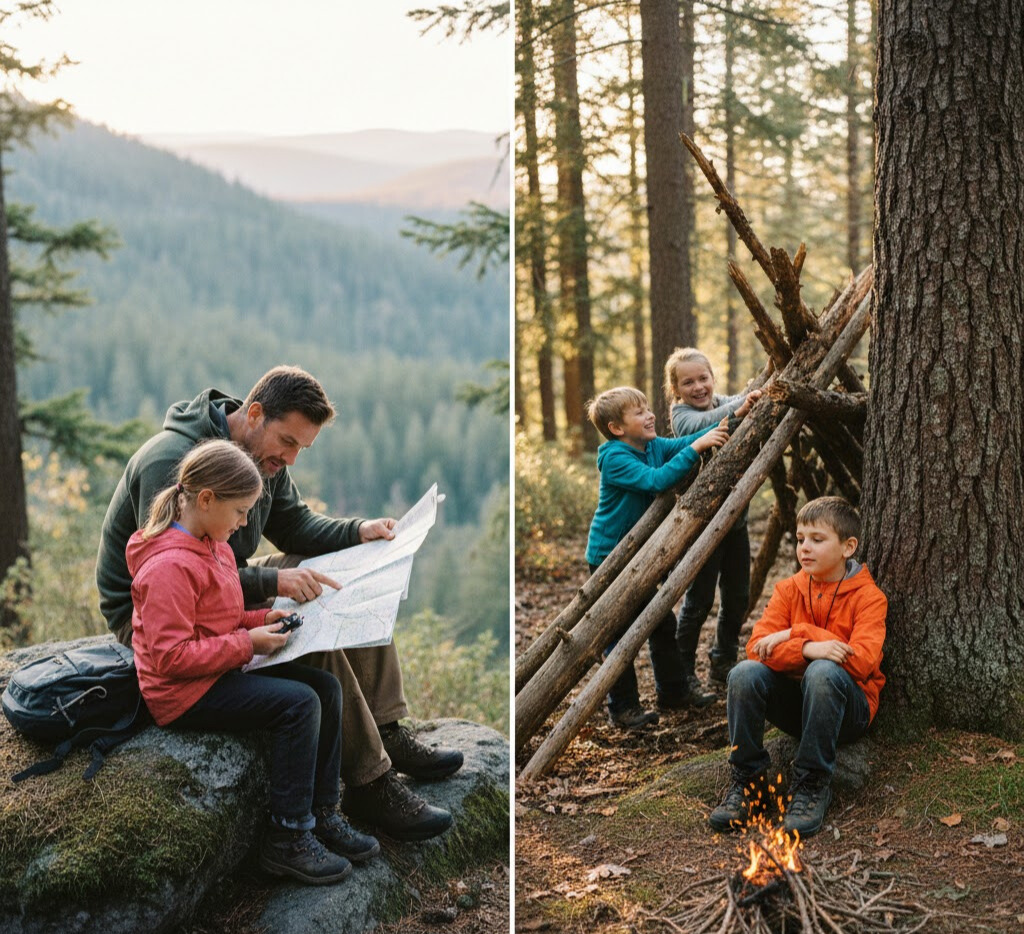
| Elementary (6–10) | Practical Tools | Basic first aid (cleaning a wound), building a simple debris shelter, and basic knot tying. |
| Middle & High (11+) | Mastery & Independence | Fire starting (with a ferro rod), water purification, and navigating with a map and compass. |
The Milestones in Detail
1. The Early Years (Ages 3–5)
At this age, survival is about visibility and stillness. Children should learn that if they lose sight of their grown-up, they should find a “friendly” tree and stay there.
- The Whistle Rule: Teach them that three sharp blasts on a whistle is the international signal for help. It’s much louder and more sustainable than a small child’s voice.
2. The Explorer Years (Ages 6–10)
Children in this bracket are ready for hands-on tasks. This is the perfect time to introduce the “Big Four” in a guided way.
- Shelter Building: Teach them how to lean branches against a fallen log to create a “debris hut.”
- First Aid: They should know how to identify and treat minor issues like blisters, scrapes, or stings.
3. The Mastery Years (Ages 11+)
Teenagers have the fine motor skills and cognitive maturity for tool-based survival.
- Fire Safety: Under strict supervision, teach them the “Fire Triangle” (Heat, Fuel, Oxygen) and how to safely extinguish a blaze.
- Navigation: Move beyond the phone. Teach them how to orient a map and identify North using the sun or a physical compass.
Parent Tip: Always celebrate the “small wins.” Whether it’s a perfectly tied knot or a whistle blast at the right time, positive reinforcement builds the confidence they’ll need in a real-world scenario.
IV. The Big Four: Essential Survival Pillars
Once a child has mastered the “S.T.O.P.” mindset, it’s time to move on to the physical skills. In the survival world, we often talk about the “Rule of Threes”: you can survive three minutes without air, three hours without shelter (in extreme conditions), three days without water, and three weeks without food.
By focusing on these four pillars, you give your child a prioritized checklist to follow when they are out in the elements
1. Shelter: Your Secondary Skin
The primary goal of a shelter isn’t just to keep the rain off; it’s to regulate body temperature.
- The Convection Rule: Teach your kids that the ground is a “heat thief.” If you sit directly on cold, damp earth, it will suck the warmth right out of your body.
- The Solution: Always build a “bed” of dry leaves, pine needles, or branches before building walls. This layer of insulation is just as important as the roof!
2. Water: Hydration Without Hesitation
While the human body can go a few days without water, dehydration leads to poor decision-making and exhaustion.
- The Golden Rule: Never drink from a stream, lake, or pond without filtering or boiling it first. Even the clearest mountain spring can hide “invisible monsters” like Giardia.
- Skill to Teach: Show them how to use a simple straw filter or purification tablets, and emphasize that they should drink before they feel thirsty.
3. Fire: Warmth, Light, and Morale
Fire is a multi-purpose tool: it provides heat, dries clothes, purifies water, and acts as a massive psychological boost.
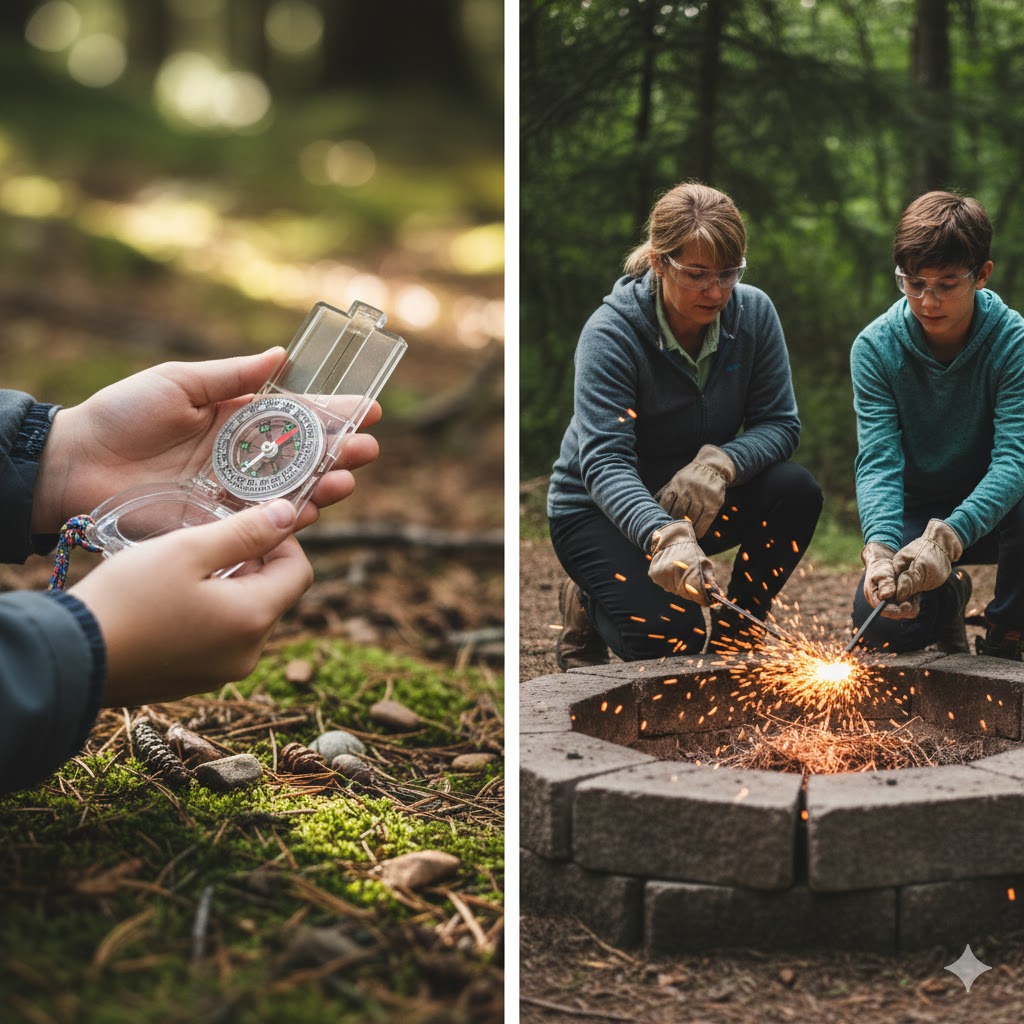
- The Fire Pyramid: Teach the “Tinder, Kindling, Fuel” method.
- Tinder: Fluffy stuff that catches a spark (dry grass, birch bark).
- Kindling: Small sticks (pencil-sized).
- Fuel: Large logs (wrist-sized or larger).
- Safety First: Always practice fire-building in a designated pit and teach the “Stop, Drop, and Roll” method alongside it.
4. Signaling: Being “Obnoxious” to Be Found
In a survival situation, “being seen and heard” is the goal. Many children naturally try to hide when they are scared; we need to teach them to do the opposite.
- The Power of Three: Three of anything—three whistle blasts, three flashes of a mirror, or three piles of rocks—is the international SOS signal.
- Bright Colors: Encourage your kids to wear a bright “safety orange” or neon hat when hiking. It’s much easier for a search helicopter to spot a neon dot than a kid wearing camouflage or forest green.
V. Gamifying Survival: Making it Fun
The quickest way to make a child lose interest in survival skills is to turn it into a dry classroom lecture. For a child, the “great outdoors” is a playground, and the best way to teach resilience is through play. By turning these lessons into games, you lower the stakes and increase the “stickiness” of the information.
Here are three ways to transform “training” into an adventure:
1. The Backyard Campout: The “Low-Stakes” Laboratory
Before you head into the deep woods, start in your own backyard. This provides a safety net where failure is part of the fun rather than a source of fear.
- The Challenge: Try to spend an entire afternoon or evening using only what you’ve brought outside.
- The Lesson: If the “debris hut” leaks during a garden hose test, or the fire doesn’t start on the first try, the kitchen and a warm bed are only twenty feet away. It allows kids to troubleshoot without the stress of a real emergency.
2. Survival Scavenger Hunts
Instead of hunting for toys, have your children hunt for “nature’s tools.” This sharpens their observational skills (the “O” in S.T.O.P.).
- Tinder Hunt: See who can find the “fluffiest” natural material (dry grass, cattails, or birch bark) that would catch a spark the fastest.
- Compass Course: Hide a “treasure” (like a favorite snack) and provide a series of simple bearings or landmarks for them to follow. “Walk 20 paces toward the big oak tree, then turn East.”
3. The “Survival Kit” Project
Ownership is a powerful motivator. Letting a child curate their own survival kit gives them a sense of responsibility and pride. Use a small waist-pack or a bright-colored pouch that they are responsible for carrying on every hike.
- The Essentials:
- The “Space” Blanket: Every kid loves these “shiny tinfoil” blankets. Show them how it reflects heat.
- The Whistle: A bright, high-decibel whistle on a lanyard.
- High-Energy Snacks: A few granola bars or fruit strips that are only for “emergencies” (or the end of the hike).
- The “Personal” Item: Let them add one small thing, like a magnifying glass or a favorite bandana, to make the kit feel like theirs.
VI. Conclusion: Resilience for Life
Teaching survival skills to children is often framed as preparing for the “unthinkable,” but the reality is much more grounded. While we hope our children never truly need to build a debris shelter or signal a rescue plane, the lessons learned in the process are universal.
These skills aren’t just for the woods; they are life skills in their purest form. When a child learns to navigate with a compass, they are learning how to find their way when they feel lost. When they practice the S.T.O.P. rule, they are learning emotional regulation and how to manage anxiety during a difficult math test or a social conflict. By teaching them to interact with nature, we are teaching them that they can handle the unexpected with a clear head and a steady hand.
The Gift of Self-Reliance
Ultimately, survival training provides a child with a profound sense of agency. In a world that often feels fragile or overwhelming, a child who knows how to build a fire, purify water, or bandage a wound is a child who knows they can rely on themselves.
That internal confidence is the ultimate survival kit. It transforms them from passive observers into active problem-solvers, ready to face the trail ahead—wherever it may lead.
Also Read : Is Prepping Fear-Mongering or Smart Planning?